The Why and How of Lighting Regulation

If you’re looking for local lighting codes, follow these links:
| Flagstaff | ♦ See Flagstaff City Code Title 10, Chapter 10-50, Division 10-50.70 |
| Coconino County | ♦ See Chapter 4, Section 4.3. |
| Yavapai County | See Chapter 6, Section 603. |
| ♦ Code meets FDSC Code Standard |
 Purpose of a Lighting Code
The principal purpose of most lighting codes is to limit adverse impacts arising from the production and use of outdoor lighting on the general (public) environment – that is, on the sky (sky glow), on other property (glare; light trespass), on the power grid (energy use and efficiency; carbon dioxide production), or on ecosystems (disturbance to animals, insects and plants). Some lighting codes focus instead or in addition on lighting “quality” on the property where the lighting is installed (illuminance, uniformity). The usual approach to regulating cross-boundary impacts is through zoning law; the approach to on–property “quality” is sometimes instead through building codes.
Legal Issues
The legal basis for regulating the use of private property in the U.S. was originally based in the common law concept of “nuisance.” Under common law, it is recognized that persons are entitled to “use and enjoyment” of their lands. If one property owner uses their land in a way that interferes with the use and/or enjoyment of another, the affected party may be entitled to a legal claim of nuisance and mitigation of its cause. Zoning laws or codes extend and improve the nuisance concept by providing proactive notice that certain uses are prohibited or limited on the basis of the cross-boundary impacts. Lighting codes, when enacted as part of zoning (the most common practice), are thus generally not concerned with aspects of lighting design that do not directly relate to cross-boundary impacts (e.g. illumination levels on the property where the lighting is installed).
Technical Aspects
To address the cross-boundary impacts of lighting use, three principal aspects regarding the design of lighting hardware or systems are critical:
- Spectrum of light sources
- Shielding of fixtures
- Amount of light
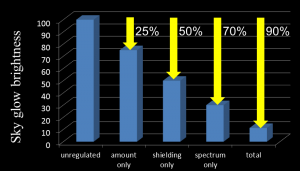
Though all three factors are important, the FDSC ranks the relative importance in limiting adverse impacts as shown.
Spectrum: Specification of yellow light sources (HPS and PCA LED, or NBA LED) for the majority of lighting uses can reduce sky glow by 70% to almost 90% when compared to white sources such as metal halide, fluorescent and LED2 (even low-CCT LED).
Shielding: Research shows that full shielding can reduce sky glow by 50% to over 90% when compared to a typical mix of partially shielded and unshielded lighting1. As shielding dramatically reduces light trespass and glare as well, it is and should be the highest priority in lighting codes.
Amount: Finally, reasonable limitations on the total lighting (lumen) amount reduce the frequency and degree of careless and/or competitive over-lighting. Lumen caps of 50,000 – 100,000 lumens per acre have been shown in a study in Flagstaff3 to reduce average lighting amounts (and thus all light pollution impacts) by 25% to 70% compared to average un-capped commercial lighting practice, and in particular applications such as service station canopy lighting by 90% or more.
1. Luginbuhl, C.B., et al., 2009, Lighting and Astronomy: see our Measuring and Modeling Sky Glow Light Pollution page
2. Luginbuhl et al., 2014; Aubé et al., 2013: see our Lamp Spectrum and Light Pollution page
3. Luginbuhl et al., 2009, From the Ground Up I: Light Pollution Sources in Flagstaff, Arizona: see our Measuring and Modeling Sky Glow Light Pollution page
Benefits
The implication of these figures is clear – lighting complying with good shielding, spectral and amount standards can have dramatically less adverse impacts on the sky and other properties. Choosing minimum reductions from the ranges described above (i.e. 70% due to spectrum, 50% due to shielding, and 25% due to lighting amount), sky glow can easily be reduced 90% – to 1/10th that seen without regulation. This is a dramatic amount, and enough to restore visibility of the Milky Way nearly everywhere including residential areas of large cities.
Similar dramatic reductions can be achieved for other adverse impacts such as glare and trespass. And all this is achieved with no compromise to utility or safety. There is much to be gained from lighting codes.
As an often critical matter in the application and enforcement of lighting codes where community legal, lighting design, and enforcement resources or expertise are nearly always very limited, lighting codes based on easily quantifiable aspects of lighting use most directly related to cross-boundary impacts are much more efficient, requiring much less expertise and fiscal resources to administer. The codes offered as models below specify shielding, lamp type and amount standards that are demonstrated to be easily and effectively interpreted, applied and enforced without specialized technical training. Lighting codes using lighting design measures such as illumination levels or illumination uniformity are much more difficult to administer, require technical expertise to interpret, implement and enforce, and do not directly address light pollution impacts of general community concern.
Though the standards necessary to achieve good light pollution control are conceptually simple, writing a technically accurate and effective lighting code is not simple. If your community is seeking effective solutions to the problems created by common careless lighting practice, we highly recommend using a code such as listed below that has been tested and found technically sound and effective.
Model Lighting Codes
Before you use a Model Lighting Code…
In 1989 innovative lighting codes were developed for Flagstaff and Coconino County that, in addition to effective standards for spectrum and shielding, were the first to widely and strictly apply an true amber spectral standard and restrict the amount of light permitted (per acre) in outdoor lighting installations. Their intent is to protect night skies by allowing lighting practices and systems that will:
- minimize artificial sky glow, glare, and light trespass;
- conserve energy and resources while maintaining night time safety, utility, security, and productivity; and
- curtail the degradation of the nighttime visual environment.
These lighting codes remain the only codes demonstrated through research and critical dark-sky analysis to actually reduce sky glow light pollution. If your community seeks to protect dark skies, the Flagstaff Dark Skies Coalition strongly recommends using these codes as a model.
These codes work. The critical true amber standard (not white or low CCT warm white) for most lighting, general limit of 35,000 fixture lumens-per-acre (reduced to 17,000 near protected areas), and practical shielding standards have been in place for over thirty years. Hundreds of developments have been successfully built, including service stations, auto dealers, and national retail franchises (Home Depot, OfficeMax, Staples, Target, WalMart SuperCenter, Best Buy, Kohl’s, etc.).